
Blog Resources for English Language and Blog Writing
 I blog in English and it behooves me to get it write – okay, at least once in a while. The challenges I face as a writer are not just generating ideas but finding the write way to convey those ideas.
I frequently need to check the spelling or definition of words I come up with in my head that look odd when I write them. I have a lot of spelling police monitoring my blog content, so while I occasionally leave a word or too for them to catch, I work hard to make sure I right good.
Sometimes I know a foreign word will work better than one in English, so I have to hunt for the proper spelling and definition to make sure it’s the right word for the right usage. I’m careful about using too much jargon, so I’m always on the look out for the definitions of acronyms and jargon phrases. And don’t forget those emoticons or smilies. 😀 Reading so many blogs every day, I also need references to help me define words, phrases, jargon, and slang in order to keep up with the changing pace of the language and technology industry.
As a writer, I revel in how words come together to convey meaning, working constantly to improve my language arts skills, so I’m including some of my references and resources for grammar, language, and blog writing. You can also find other writing references in the first post in this series, Blogging Resources and Sources to Help You Blog.
Mục Lục
Writing Guides
 There are a lot of writing guides and resources on the web, with a lot of bloggers covering writing techniques and training. My blog writing tends to be more technical and educational rather than editorial, so I regularly refer to the references on Ask Oxford – Better Writing from Oxford University, Daily Writing Tips, and Strunk, The Elements of Style (1918 edition).
It is critical for bloggers to learn how to cite other bloggers and references. The Citing Internet and Other Electronic Resources from Binghamton University Libraries is a well-rounded list of example sources and references on how to use citations on your blogs.
The Electric Eclectic offers one of the most comprehensive listing of research and technical references for any type of writer or researcher. It’s a mishmash of tons of links, websites, and blogs but all excellent resources for writers and bloggers with professional writing technical sites, research references and resources, brainstorming sites, specialty sites, and sites and blogs by writers. And everything in between. You can spend days with all the resources listed.
If you are going to write, you have to know how to edit your writing. Most bloggers edit their work on the computer, but if you are ever in need to edit the printed page, especially if working with others, you need to know the most Common Proofreading Symbols and Abbreviations used in editing. These symbolic instructions tell the editor or writer what changes need to be made in the text. I wish there were such symbols to use with Google Docs, email, word processors, and other online editing tools, even a WordPress Plugin, that made editing online documents for others much easier than coloring text instructions within the content.
Standards of Archival Description Handbook is a guide for technical standards, conventions, and guidelines used by archivists to help you with research on technical and archival materials. I find this helpful when researching articles for my family history genealogy blog, but also for technical references for my other blogs.
iLoveLanguages – Your Guide to Languages on the Web was called the Human-Languages Page, it offers over 2000 language tools and resources online to help you dig into online language lessons, translating dictionaries, native literature, translation services, software, language schools, and more. I use this when I’m trying to find a foreign language resource or resource and I’m coming up empty elsewhere.
BUBL Link Catalogue from Strathclyde University, Glasgow, offers a variety of Internet resources on academic subjects of which I like the section on Authorship, writing and editorial techniques.
Other writing resources I’ve used from time to time include:
Battling English Errors
 If you learn from your mistakes, and learn which mistakes are most common in writing, hopefully, you will learn and not repeat those mistakes. I used to keep a list of all the words I most commonly messed up, using it like a checklist when editing (did I spell “from” as “form” again?) and it helped me brake a lot of – I mean break a lot of bad spelling and grammar habits.
Still, every now and then I need to be reminded, especially for those moments when my brain goes thunk and I can’t remember if it is effect and affect. I refer to Common Errors in English, Confusing Words, and Commonly Confused Words in English to kick start my head into righting the write right.
Clichés: Words the cat dragged in
Well, the writing’s on the wall, and when you really need a good cliché, where do you turn? I turn to Cliché Finder and ClicheSite to help me find the right euphemism and figure of speech to help me make my blogging point.
Double Entendre
Sometimes an non-English word is the right word to use in a writing situation, but spell check doesn’t always recognize it. Associated Content has an article on the common foreign words and phrases used in English that often helps me out.
Also, since I do write for an international English speaking audience, I use the The American-British British-American Dictionary occasionally to cover my English-as-a-foreign-language bases.
Acronyms Aren’t Always Shortcuts
 I recently wrote Using Abbreviations May Hurt Your Blog for the Blog Herald which discusses the pros and cons of using abbreviations and acronyms on your blog. Whether you use acronyms, spelling out Hyper Text Markup Language or HTML, depends upon your audience and the recognizability of the acronym. Today, MSIE, IBM, MS, IE, HTML, CSS, and other acronyms are part of our day-to-day online life, but if you are writing for an audience unfamiliar with those letters, consider spelling them out. Use the spelling or acronyms searchers use to find your content.
To help me learn what all these letters mean, here are some acronym references and dictionaries I use:
Emotions, Emoticons and Smileys
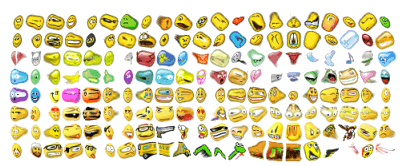 BTW, there are also conversation abbreviations I avoid using, IMHO, that too many bloggers use. While I try to avoid using those little emotional keyboard strokes in my blog posts known as emoticons, smilies, and smileys, I can’t help it. 😀 Here are some of my resources for figuring out which combinations of keystrokes will pop up in those smiling, frowning 😦 , confused :% , angry :# , and grinning faces 😉 , and what all those letters mean. LOL.
Netlingo – Online Dictionary is a resource listing of jargon and smilies used on the web in chats, blogs, email, and everywhere. They have an extensive listing of online acronyms and smilies such as:
Other resources I use to help remember what keystrokes make which faces and how to use smilies properly in a WordPress blog are:
Deciphering the Symbols (and Math) of Language
 Symbols Dictionary is an online encyclopedia of “Western Signs and Ideograms” which takes the Da Vinci Code to new heights. I’ve used this with my web design on occasion for inspiration, but it’s invaluable to help you think visual with the written language.
For example, we use the plus sign (+) in math, programming languages, and visually in web and computer software design. Universally, the symbol represents addition, but it also means combination. According to the Symbols Dictionary, it goes back even further with its symbolism representing the four points of the compass and the weather gods in pre-Columbian American. In Chinese, it stands for perfection with 10 the most perfect number. Astrological symbolism note the plus sign a symbol for “matter, the earthly life, the plane of physical existence,” which in Chinese ideography means “ground.”
Another problem with symbols is how to use them in your writing. For example, WordPress is a trademark, so should I be writing WordPress™ every time I write it? KleenexTM wants the respect its poor tissues don’t receive since their name has become generic over the years. What about ©? How do I make these symbols appear in my browser?
What about measurements? Is it 10in, 10in., 10″, or 10 inches, or maybe 10mm or 10 mm? In English, commas are used to separate large numbers into sections for easier reading such as 534,236,984, however, other languages use periods do do the same, 534.236.984, leaving commas for decimal points such as 43.654,98. Which one is the right one to write for your needs?
Here are some of the resources I use to remind me of how to write symbols and code:
Copying, Copy Cat, Copyright Violation, Content Theft, and Scraping
 Known as plagiarism, copying our blog content and using it for nefarious or out of ignorance is a plague on the web. In an upcoming collection of resources, I’ll cover researching copyright laws, but here are the tools and resources I use to write about intellectual property and copyright violations in connection with blogging.
Jonathan Bailey of PlagiarismToday (feed) is my main source in the last year for expertise and resources on plagiarism and copyright violations. He offers consultancy, expert advice, and resources on copyright issues, helping you track and stop content theft.
Mahalo – Literary Plagiarism Tools and Resources offers extensive links and information on plagiarism and copyright violations, including a Javascript bookmarklet, Plagiarism Detection Tool, to help you compare the page you are viewing through similar content via Google – which might help you track down the original content if you have any doubts about this not being original.
I offer a lot of tips and resources I continue to link to in What Do You Do When Someone Steals Your Contentand Finding Stolen Content and Copyright Infringements, and even offer Stop Content Theft Buttons and Badges to put on your blog to help educate others on copyright. Some of my other resources include:
Finding Things To Write About
I’ve written a lot about how to find things to write about on your blog, listing tons of resources for inspiration and motivation. Inspiration to write comes from so many sources, it’s often hard to name them all. I’ve gotten the best ideas from overheard conversations, an off-topic comment in a discussion, books, magazines, televisions, movies, poetry, quotes, news stories, and other bloggers. Keep your mind open and you will see blog stories everywhere.
Here are some articles on finding something to write about on your blog that list resources and tips:
In the next article in this series, I’ll share with you my online resources that help me blog and do the research for my blog articles, including how to find the facts, find supporting evidence, and chasing the news in my industry.
Articles in this Series

Site Search Tags: blogging tips, blog resources, sources, resources, blog writing, writing, writing tips, writing help, writing advice, how to write, grammar, spelling, definitions, dictionaries, writing guides, writers guides, guides, blog writing, blog posts, finding content, finding stories, writing stories, news, writing news, learning to write, learning to blog, blog learning, how to blog
 Subscribe
  Via Feedburner
  Subscribe by Email
  Visit
Visit
Copyright Lorelle VanFossen, the author of Blogging Tips, What Bloggers Won’t Tell You About Blogging.









![Toni Kroos là ai? [ sự thật về tiểu sử đầy đủ Toni Kroos ]](https://evbn.org/wp-content/uploads/New-Project-6635-1671934592.jpg)